Recruiting is mostly noise. For a DSP without a deliberately built hiring workflow, a realistic funnel takes in about 75 applications to produce 1 driver who's still on the road at 90 days. Seventy-five to one. That's not a broken funnel — that's the accidental one, the ratio a hiring process settles into when nobody designs it. A deliberately built funnel compresses that same ratio to 20-30 qualified applicants per hire — the full math on that compression is here. But until you build one, 75-to-1 is what you're running. Seventy-four people go in and disappear, and one is still wearing the vest three months later.
Now put that ratio against a real operation. If you need 30 drivers on the road every day, turnover means you're never hiring one driver — you're hiring all year long. And when peak season ramp-up hits, the math stops being abstract: at 75-to-1, adding a handful of drivers means processing hundreds of applications in a matter of weeks. Nobody handles that volume by hand and does it well.
So the real question in DSP recruiting is never "how do I get more applications?" It's this: what, exactly, is removing the other 74 — and did you choose it?
After running recruiting inside active Amazon DSP operations, I can tell you that almost no owner can answer that question. Not because they're bad at hiring. Because nobody ever showed them that their hiring process is a funnel built from filters — I call it the 75-to-1 Funnel — and that every one of those filters is doing its job whether they designed it or not.
You already run a 75-to-1 funnel
Here's the part most owners have never considered: you cannot opt out of filtering. If you didn't build filters deliberately, you still have them. They're just accidental.
Your job posting is a filter. Your application questions are a filter. How fast you respond to an applicant is a filter — one of the most brutal ones you own. Your phone screen, your interview, your background check and drug test, Amazon's onboarding systems, Amazon's training week: all filters. And at the very bottom of the funnel sits the final filter, the one that never misses: the job itself. Ten-hour shifts, 200-plus stops, weather, dogs, apartment stairs. The route will filter anyone the earlier layers let through.
Every candidate who starts and quits in week one wasn't a hiring mistake, exactly. They were filtered — just at the most expensive possible layer.
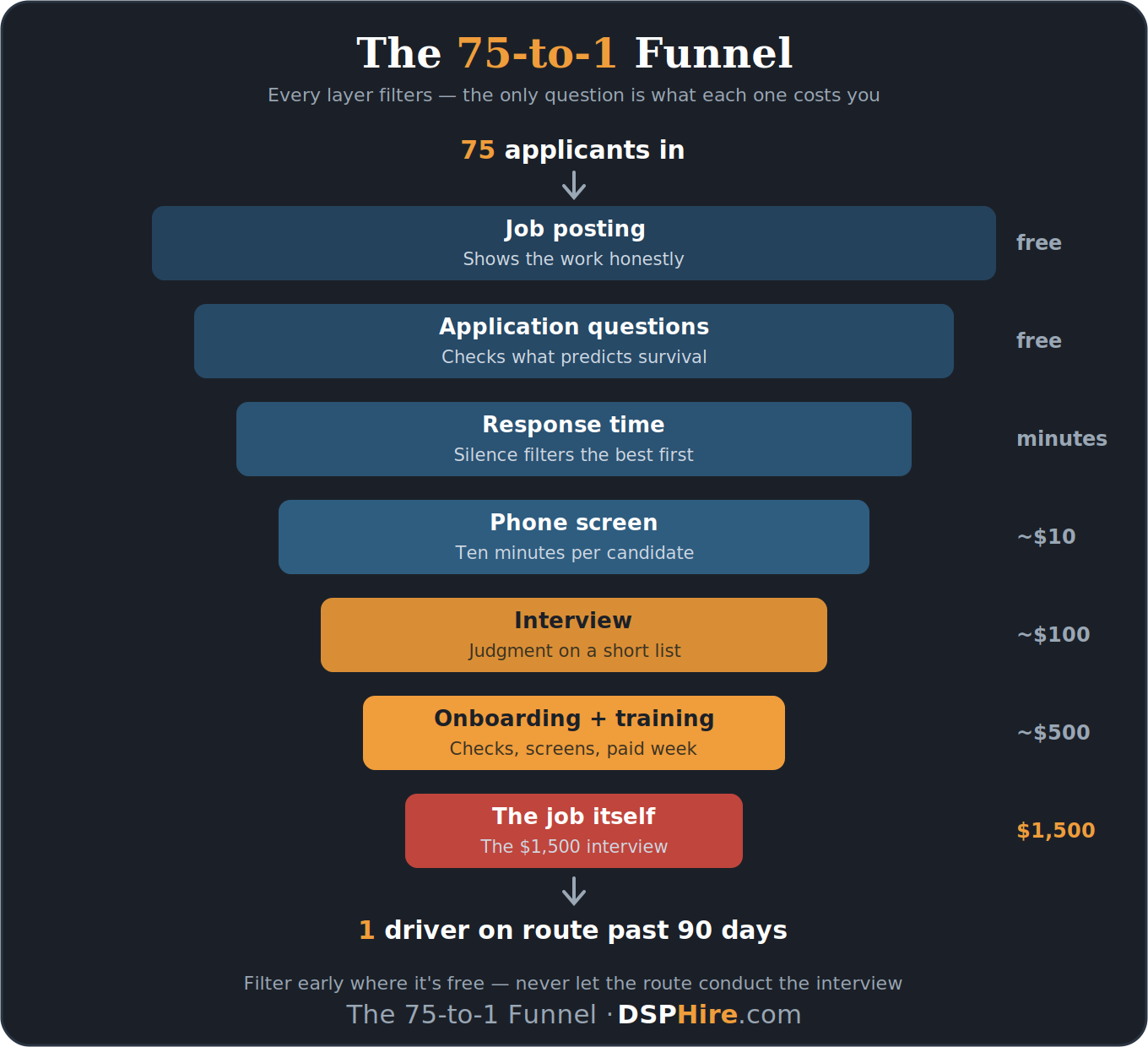
Filters get more expensive as you go down
This is the economic engine of the whole framework, and it's the reason recruiting quality matters more than recruiting volume.
A candidate filtered out by your job posting costs you nothing. They read it, understood what the work actually is, and didn't apply. Free.
A candidate filtered out by a screening question costs you almost nothing. A few seconds of automated logic.
A candidate filtered out at the phone screen costs you ten minutes.
Now keep going down. A candidate who passes everything and gets filtered by the drug screen or MVR pull cost you real money. One who gets filtered by Amazon's training week cost you background check, drug test, onboarding hours, and paid training. And one who gets filtered by the route itself — quits at day 9 because nobody told them what 250 stops in July feels like — cost you every layer above: easily $1,500, and that's a conservative number — plus the scorecard damage a struggling rookie does on the way out, plus the open route you're now covering with overtime.
Same candidate. Same outcome. The only variable is which layer caught them — and the price difference between the top of the funnel and the bottom is the entire cost of your turnover problem.
The difference between a weak recruiting operation and a strong one
It is not effort. It is not spend. I've watched operations pour money into Indeed while their funnel leaked at layers they didn't know existed.
A weak recruiting operation has essentially two filters: a person's gut feeling, and the job itself. When the human filter isn't really filtering — when the interview is fifteen friendly minutes confirming someone has a pulse and a license — then the job becomes the primary filter. And the job is the most expensive filter in the funnel. Those operations aren't recruiting. They're paying $1,500 a head to let the route conduct interviews.
A strong recruiting operation looks completely different, and from the outside it can look like it's doing less. Multiple cheap layers fire before a human ever spends time: a job posting that shows the work honestly instead of selling it, screening questions that check for the things that actually predict survival (sustained physical work history beats driving experience, every time), response automation that catches applicants in the first hour before they evaporate. By the time a candidate reaches a skilled recruiter, most of the noise is already gone — and the recruiter is applying judgment to a short list, not triaging a flood.
Then HR filters again through onboarding. Then Amazon's training filters again. And here's the target that matters: the goal of every layer above the bottom is to make sure that when the final filter — the job — gets its turn, it finds nothing left to remove. Can they make it past week one? Past 90 days? If your earlier layers are built right, the answer was decided before day one.
Where is your funnel leaking?
You can diagnose a funnel from its symptoms, because each leak has a signature:
High interview no-show rate? Your response-time filter is firing at the wrong layer. Applicants are being filtered by silence — yours — and the ones who ghost you were often the employable ones who got hired by whoever called back first.
Drivers quitting in the first 30 days? Your job posting is selling the job instead of showing it. You've turned off the cheapest filter in the funnel, and the route is doing that filter's work at $1,500 a head.
Interviewing constantly but rarely hiring? Your screening layer isn't filtering, so your most expensive human hours are being spent on noise that a $0 question should have caught.
Good hires who fail Amazon's training? You're recruiting forward from the application instead of backward from the last filters. The funnel should be tuned to what training and the route will demand, not to what the résumé offers.
Every one of these is fixable, and almost none of them are fixed by spending more on job ads. They're fixed by moving the filtering up the funnel — earlier, cheaper, deliberate.
The uncomfortable summary
You are running a 75-to-1 funnel today. The only question is whether you built it or it built itself. Accidental funnels all share the same design flaw: they filter late, at the layers where filtering costs the most, and the invoice shows up in your books labeled as "turnover."
If you want a second set of eyes on yours, that's literally the work I do.